
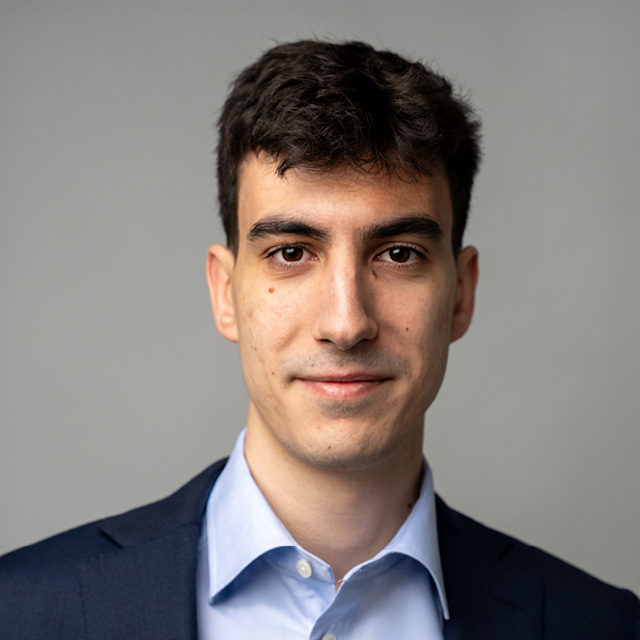
Jason Najjar ’24
Great American Insurance Group: Fine Art Underwriter
New York City, NY
WFU Class of 2024
Majors: Art History, Economics
Minor: Arabic
Tell us about your journey from graduation to where you are today:
In the spring of my Senior year, I had the opportunity to purchase contemporary art as a member of the 2024 Buying Trip. This experience allowed me to apply my classroom learning to the realities of the New York art market, serving as a valuable bridge from academia to the professional world. It was also during this trip that I met my current boss, Andrew Gristina (a fellow Demon Deac), at a networking event hosted for the Buying Trip.
I didn’t have a job lined up immediately after graduation, so I spent the next five months job searching, focusing on opportunities within the New York art scene. Based in NYC during this time, I worked as a dog walker while networking extensively and attending industry events. My connection with Andrew, first established during the Buying Trip, continued to develop through these events and ultimately led to my role at Great American Insurance Group within their Fine Art Practice.
How much did your studies and general experience at Wake inform or drive your career path?
Wake Forest played a pivotal role in shaping my career path. My interest in art began in Professor Curley’s class my sophomore year. I enjoyed Professor Curley’s class so much that I decided to declare an art history minor at the end of my sophomore year. My subsequent experience in the art department led me to change my art history minor to an art history major.
Now, as a fine art underwriter, I have found the perfect intersection between my passion for art history and my study of economics. As previously mentioned, my connection with Andrew Gristina was formed during the 2024 Buying Trip. That experience was made possible by my studies and involvement in the art department. So, in short, Wake sparked my interest in art, equipped me with a valuable skillset applicable to the art insurance market, and provided the platform for me to meet Andrew.
How did you find and apply to your job? Any tips or suggestions for the student audience on networking, interviewing and applying for jobs?
I found that applying to roles through NYFA and LinkedIn was very useful. I was able to get several interviews through these two sites. However, the most useful tool is your network. Developing my network (while at Wake and after graduation) is ultimately what led to my first hire. These are connections that can help land a job, but also can help you succeed in whatever role you may find yourself in. It can be intimidating to reach out and speak with people, but it is the best way to push your career forward. I found that the Wake alumni network is willing to help and Wake professors are willing to facilitate those conversations. All one must do is ask!
What is your favorite part of living and working in New York? What is the most interesting thing going on in the art scene there at the moment, in your opinion?
I was born and raised in NYC. I have lived in the same apartment my whole life! I absolutely love New York. New York provides an incredible array of opportunities in the arts, whether you’re immersed in academia, working in a gallery, a design firm, an auction house, a shipping company, or pursuing any of the various career paths available in this industry. Outside of one’s career, New York also has so much to offer in terms of dining, arts and culture, entertainment, and so much more.
I think the most interesting thing in the current New York art scene is the evolving museum space. Just this year, the Frick has reopened at its 5th Avenue location after renovations, the New Museum is opening its expanded space, the Studio Museum of Harlem is set to open a new space, the Met announced a new contemporary wing, and so on! Visiting museums is a great activity, and New York offers some of the most amazing museums in the entire world. These museums are always evolving, and this year has been a testament to their exciting nature.
What is your favorite part about working as a fine art underwriter?
Fine art insurance is fundamentally an insurance product, designed to mitigate financial risk and protect the value of artworks. In other words, underwriting art insurance is ultimately focused on the insurance side of things. This aspect of the job aligns well with my interest in economics. Additionally, I also get to interact with art every single day. Part of my job involves looking at and evaluating galleries, private dealers, private collections, corporate collections, museums, artist studios, shippers, auction houses, institutions, conservators, framers, and universities. I also get to attend art fairs, gallery openings, museum events, and several other exciting activities. I am getting exposure and meeting great people across the industry. The blend between my interest in economic markets and art, in addition to the exposure I am getting, makes this a great job.
What and where is next for you?
I will be in New York City for the foreseeable future. I just started my role at Great American, so my plan is to learn as much as I can from Andrew and grow (both personally and professionally) over the coming years. I am hopeful and confident in my ability to learn, while simultaneously making a meaningful impact on my firm’s book of business and contributing positively to the art world more generally. I also hope to continue expanding my network and continue building connections across this industry.
Any other kernel of advice you’d like to impart to the readers?
The art world is an exciting and everchanging environment. It can be difficult and intimidating to break into. Please feel free to reach out to me if you need any advice, guidance, or someone to bounce ideas off of!